
From idea to a working product.
We design and develop your hardware, firmware and software, from the first idea to a proof of concept, prototype or MVP, then support your manufacturer into production. We do not manufacture.
A reply in two working days. An NDA before the details. Attach a sketch, a specification or design files.
Track record
Electric-vehicle and UAV work by the studio’s engineers, before and at SPATICS.
Start at any stage. Stop at any stage.
Each stage ends with something you can hold, measure or show, and a go or no-go before the next. Pick the one you are at.
Idea
We write the requirement with you, choose the architecture, parts and platform, and name the risks before money goes into hardware.
A requirement, an architecture, a budgetary BOM and a plan.
Start with an ideaProof of concept
A bench build on development kits, or a first board, that proves the one thing nobody is sure of: the power stage, the sensor, the link or the algorithm.
A working bench demonstration, measurements and a go or no-go.
Start with a proof of conceptPrototype
Your own schematics and layout, firmware brought up on your boards, and the first units built and tested against the requirement.
Working prototypes, the design files and a test report.
Start with a prototypeMVP
A revision that fixes what the prototype taught, release firmware, the app or dashboard around it, and pre-compliance tests before the lab.
Pilot units, release firmware and pre-compliance results.
Start with an MVPProduction support
Design for manufacture and test, production test fixtures and software, pilot-run support and cost reduction, beside your manufacturer.
A design your manufacturer can build and test, unit after unit.
Start with production support
Hardware we design.
Mixed-signal and power electronics for drones, electric vehicles, energy and industry, built for harsh conditions and for the production line.
Battery management systems
Monitoring, balancing and protection for lithium packs, from drone batteries to electric-vehicle and storage packs.
- Cell count, chemistry and current to your pack
- Protection, state of charge and CAN telemetry
- Functional-safety design to ISO 26262
- Charger and pre-charge integration
Power electronics
Chargers, converters and drives designed for efficiency, cost and harsh conditions.
- GaN converters and chargers: PFC, CLLC and DAB
- BLDC motor controllers with field-oriented control
- UAV battery chargers with active PFC
- Simulated in PLECS, LTspice and Ansys Maxwell
Flight controllers and avionics
Controller boards built around the sensors, radios and interfaces your aircraft carries, from the same lineage as the SPATICS suite.
- IMU, barometer and GNSS integration
- Motor-controller and payload interfaces
- Redundancy and watchdog design
- Ready for PX4 or ArduPilot bring-up
Telematics and connected devices
Devices that report what a vehicle, battery or machine is doing, as it happens.
- CAN links to vehicle and battery systems
- Telematics control units with wireless connectivity
- Real-time data acquisition
- Vehicle cluster integration
Measurement and control
Controllers that measure precisely and switch reliably, such as genset and energy controllers.
- Energy metering and accurate AC measurement
- Relay control and sensor interfacing
- Fast control loops on real-time microcontrollers
- Built for heat, vibration and supply noise
Custom PCBs
Sensor boards, power stages, interface adapters and payload electronics: any board missing between your requirement and a working system.
- Mixed-signal schematic capture
- High-density layout for EMI, thermal and fit
- DFM review with your fabricator
- Prototype builds and bring-up
Software that makes it work.
From the firmware on the board to the screen in the operator’s hand and the dashboard in your office.
Embedded firmware
Firmware for the boards we design, or for yours, bare-metal or on an RTOS, written to run for years.
- STM32, TI MSPM0 and C2000, Infineon and Microchip
- Drivers, bootloaders and field updates
- Control loops, protection and diagnostics
- CAN, UART, SPI and I²C protocol stacks
Flight-stack integration
Your aircraft and payloads running on PX4 or ArduPilot, with no more custom code than they need.
- Board support for custom flight controllers
- Drivers for your sensors and payloads
- DroneCAN peripherals and MAVLink messages
- Parameter defaults, tuning and log review
Ground control and desktop apps
The software an operator uses every day, built for your vehicle rather than every vehicle.
- Custom QGroundControl builds in your brand
- Simplified screens and pre-flight checklists
- Payload and camera controls
- Configuration and service tools for your team
Edge AI and computer vision
On-board intelligence on a companion computer beside the flight controller.
- Jetson and Raspberry Pi class companions
- Detection, tracking and inspection analytics
- MAVLink and ROS 2 links to the autopilot
- Video streaming to the ground
Test rigs, HIL and production test
Rigs that test the design before it flies, and every unit before it ships.
- Software- and hardware-in-the-loop simulation
- Automated bench and regression tests
- End-of-line test software and fixtures
- Calibration and flashing tools for the line
Dashboards and cloud telemetry
Data from the field, turned into something a team can act on.
- Device-to-cloud telemetry pipelines
- Fleet dashboards, alerts and reports
- Over-the-air update services
- Workflow automation with Python and n8n
Production support, not production.
We take a design to the point where a manufacturer can build and test it, and we stay beside them while they do. We do not run a production line, so we have no reason to tie you to one.
- Design-for-manufacture and design-for-test reviews with your manufacturer.
- A bill of materials with alternates and domestic sourcing notes.
- Production test fixtures, end-of-line software and test procedures.
- Pilot-run and first-article support, failure analysis and fixes.
- Yield improvement and cost reduction as volumes grow.
- Design toward IEC 61000, CISPR 25, ISO 16750, AIS 156 and AIS 048, with pre-compliance tests before your lab visit.
- ISO 9001 and ISO 26262 design documentation.
What we do not offer
- Volume manufacturing: your manufacturer builds the product.
- Stock, distribution or sale of units.
- Certification: an accredited lab certifies; we prepare the design and the evidence.
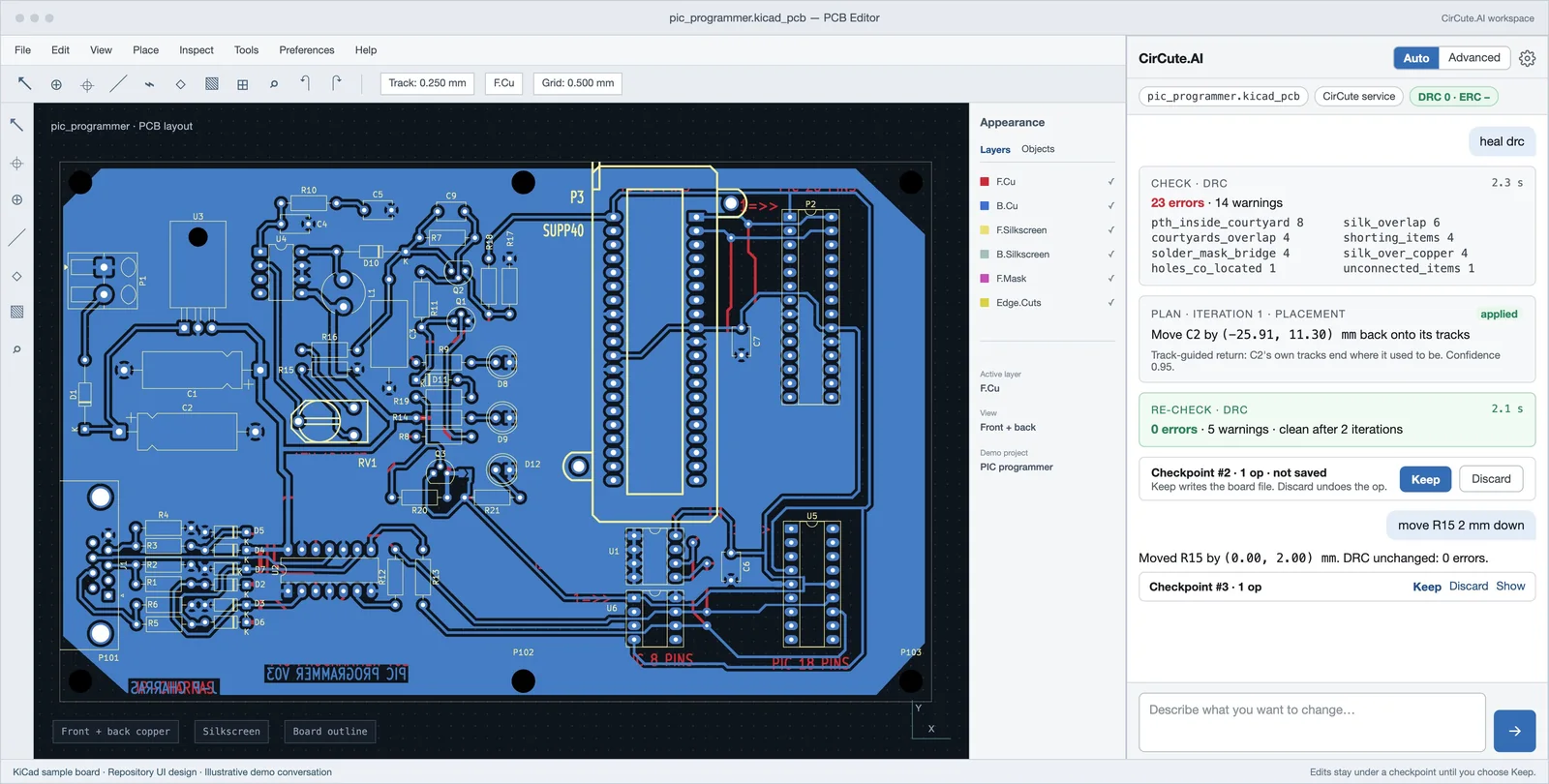
Circute.AI, our design copilot.
The studio designs boards with Circute.AI, our conversational AI-EDA plugin for KiCad. It edits, places and routes on request, checks every change against the design rules, and writes nothing until an engineer keeps it. Your team can use it too.
How an engagement runs.
Brief
A call and a written requirement: what it does, where it lives, what it connects to and what it must survive. Under NDA when you need one.
Outline scope
Within seven working days: our questions, the stages we propose, the deliverables and the milestones.
Build in milestones
Schematics signed off before layout, firmware shown running on hardware, and test results at every milestone.
Hand over
Design files in standard formats, firmware and software builds, test procedures and reports, and support while your manufacturer builds.
Ways to work with us.
Fixed-scope project
One statement of work, split into milestones you sign off, each with its deliverables.
Design sprint
A short, focused sprint on one risk: a power stage, a firmware feature or a test rig.
Design review and audit
Your schematics, layout, firmware or failing test reviewed, with a written list of what to fix and why.
Engineering retainer
Part-time senior engineering on call for your team, with mentoring and knowledge transfer.
What you receive.
- Requirement and architecture documents.
- Schematics and PCB layout in Altium Designer, KiCad or your EDA tool.
- Fabrication and assembly outputs: Gerber or ODB++, a BOM with alternates and assembly drawings.
- Firmware and software builds, with build and flashing instructions.
- Simulation results, test procedures and test reports.
- Prototype or pilot units, when in scope.
For OEMs, startups, system integrators, research teams and government programmes, business to business and business to government.
Questions before you write.
Do you manufacture?
No. We design, build and test prototype and pilot units, then support your manufacturer through production. Volume manufacturing stays with your manufacturer.
Is it only for drones?
No. The studio’s engineers have shipped battery management systems, chargers, telematics and genset controllers for electric vehicles and industry, as well as UAV electronics.
Will you sign an NDA?
Yes. We sign one before the detailed brief, and work under programme security requirements where they apply.
Who owns the design?
Ownership of the design files and the code is agreed in the statement of work, before work starts.
What do you need to start?
A few sentences on what it should do. A sketch, a specification, a reference product or existing design files help: attach up to five files to the form.
How long will it take, and what will it cost?
That depends on the stage and the risks. Each engagement is a fixed statement of work with milestones, and the outline scope we send within seven working days sets out the stages and the next step.
Which tools do you use?
Altium Designer and KiCad for electronics; LTspice, PLECS and Ansys Maxwell for simulation; STM32, TI, Infineon and Microchip microcontrollers; PX4, ArduPilot and QGroundControl for aircraft. Where you have formats of your own, we deliver in them.
Tell us what you are building.
A few sentences are enough. A SPATICS engineer replies with questions within two working days, and sends an outline scope within seven: the stages, the deliverables and the next step.
- No cost and no obligation for the outline scope.
- An NDA before the detailed brief, if you need one.
- Up to five files: a sketch, a specification or design files.